
Meet the Artist: Lara Somogyi

Written by: Madeline Duffy
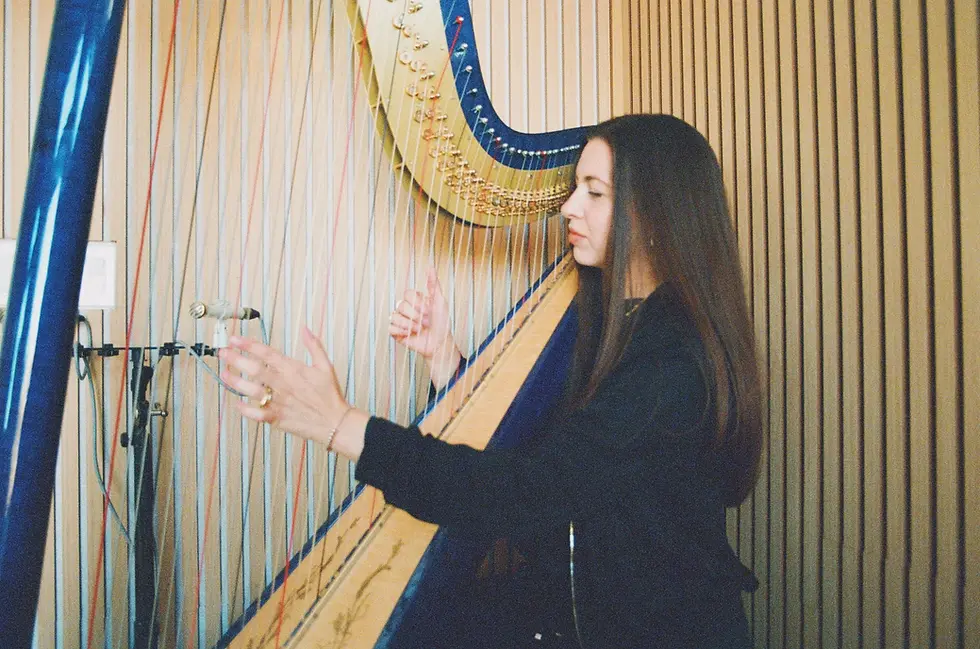
Lara Somogyi (Laura Sih-moji, like emoji) is a California-based composer and harpist. Growing up in Hawaii and New York, she has since relocated to Los Angeles and has worked with artists and groups from Evanescence to Josh Groban. Somogyi has been featured as a harp soloist on many scores, including Bleeding Finger’s the Simpsons, Netflix’s Bridgerton, and Hans Zimmer’s score for Disney’s The Lion King.
Her new album, a [time] patterned, came out last month on Decca Records under Mercury KX, their modern classical imprint. On the album, Somogyi explores the concept of time through the senses.
MD: First of all, congrats on the new album. It’s beautiful. I like that sensory stuff is a central topic of the album. When I make music, I tend to think about what it represents to me not just in the context of sound but also visuals and textures. Every waveform and effect, every possible sound in a synthesizer represents a particular feeling to me. Can you talk about what it was like composing the album with that in mind, for listeners who may not fully understand that?
Lara: Thank you. It sounds like we are similar in that we both feel music in that way. Composing the record was purely out of curiosity for each instrument . What can be unlocked from each instrument in each way? The harp is a big, lucious sonic palette and different kinds of extended techniques can really change the sound and help listeners feel the music in a different way.
MD: In an interview with the Line of Best Fit, you said, “There’s nothing about time that’s numerical to me. It’s all sensory. It’s all based on how you’re experiencing things. It’s like: how did it smell that month? The summer that smelled like fresh grass. What was the sound through the trees in that moment?” What do you mean by this? How is time represented in your new album?
Lara: I found that the album for me represented specific moments. Feelings can be a meaningful marker and something that you gravitate towards more than like, “oh, one two years ago” and I think of things based on how they made me feel rather than the amount of time passed.
MD: In a 2018 interview with Spitfire Audio, you mention that you worked with Robbie Williams and Rufus Wainwright. How were you able to get in contact with these musicians? Even here in Metro Detroit, with all of my connections, I’ve never been in a studio with someone so famous.
Lara: I’m sure they’ll be coming through! It’s through word of mouth, where a friend at Royal Academy of Music was working with them and they needed a harpist. And the same thing when I moved to Los Angeles, where you would play and it would river and flow into the next person who was interested in those kinds of sounds. Guy Chambers, he was really influential and eye opening. The Rufus experience was so pivotal to me; I still have the transcription from it.
MD: I’ve worked with a few people in the area but not anyone too famous. Josh Malerman, the dude who wrote Bird Box is in a local band and I got to record him once. He’s nice.
Lara: I also worked with Camilla Cabello, Ariana Grande, Bonobo. Collaboration is a beautiful thing.
MD: What was it like working with Bonobo?
Lara: Simon is so kind. He’s a cool dude. He’s prolific in the way he uses instruments and the way he ties acoustic and electric instruments together. He has this way of bringing sounds together in a way that’s luminous.
MD: I like to think that’s how a lot of composers are. I listened to Bonobo a lot in middle school, mostly the 2010 album [Black Sands] and The North Borders. Which one(s) did you play on?
Lara: I played on Fragments.
MD: What is your favorite key to write music in?
Lara: Ooh! Good question. I think any flat key on the harp. There are no levers that touch the strings in flat keys. Levers affect the pitch of each string. Without them, the strings are in their natural state.
MD: I watched your NAMM 2019 performance. I really like the way you used the harp to mimic a synthesizer. That one sound, it sounds a little like a detuned saw wave with numerous voices with a pluck shaped envelope that controls a filter and some echo. How did you achieve that using a harp and pedals?
Lara: Thanks for watching that! A blast for the past. I don’t remember what I did for that one but probably something with a lot of reverb and a lot of delay. I like to run reverb through some stuff. I don’t remember the name of the piece. Tremolo after the reverb. I like to combine stuff together. I think it was mostly or all Roland boss pedals on that show. I might’ve used one called a Slicer. I think combinations of pedals in different orders are really exciting and can facilitate different palettes of sound.
MD: It’s interesting hearing people talk about pedals, because usually when I imagine with a bunch of pedals I think of that one YouTube interview from 2014 with Wata from Boris where she just shows off all her pedals and there’s just tons of them.
MD: Was the visual for the song “mirabel” inspired by the ars subtilior? I learned about that in college. It was my favorite topic that I studied throughout all of my music history classes. (It’s a beautiful song, by the way.) What does the visual represent in the context of the album? Is it by any chance related to the track “sitting circle”?
Lara: Great question! It’s amazing you know about that. It was not directly inspired by it, but more so inspired by Music for Airports and [György] Ligeti, but that’s amazing that you are familiar with that! At the conservatory, I got to play this orchestral piece where we all played individual phrases on a loop until the piece told us not to. It was a Leif Segerstam piece where you would move on to the next phrase when you felt you were ready, and I felt that was a cool way to feel the music. A nice bridge between improvisation and non-traditional notation.
MD: I think of the ars subtilior composers, as like, the SOPHIE of the 1300s, and she is my favorite producer, so there’s that.
Lara: That’s a great quote.
MD: What are your favorite albums that combine elements of classical music with pop?
Lara: With pop! Ooh, that’s a great question. Off the bat, because it’s so recent, the new Rosalia record. There’s Bjork on it, so many amazing contemporary classical composers that made it with her.
MD: I saw that Caroline Shaw is on it and I love her work.
Lara: Perfect that you said that, she’s one of my big inspirations! It’s so cool to see all these composers working with a big pop artist.
MD: I did a paper on one of Shaw’s pieces recently. One of the ones with So Percussion.
Lara: I love Sō Percussion! You have such a wide and robust knowledge of music. It’s so cool! It’s fun to talk to you.
MD: What composers primarily influenced this record?
Lara: Hard question, I admire many composers. Arnolds, Frahm, a lot of harp stuff, Debussy, big arpeggios are exciting to me. Olivernos, Dawn of Midi, Sakamoto, Cyrus Reynolds. Wendy Carlos as well. Especially her record Sonic Seasonings. Great record! I highly recommend that one and Digital Moonscapes.
MD: I studied Wendy Carlos Olivernos in my music composition classes.
Lara: Wait, I wanna hear about those. Where did you study? Detroit?
MD: Yeah! I just graduated with a Bachelor’s in Music.
Lara: Nice! Congrats! What an accomplishment. I’m so excited for you.
MD: My professors taught me a lot about synthesis and sound design and all this stuff that electroacoustic composers would do in their music. They showed us Different Trains by [Steve] Reich and how he would use delay and stuff to create new textures in his music.
Lara: He’s also a big inspiration to me. Music for 18 musicians is well played in my house. Dawn of MIDI is another huge inspiration to me.
MD: I’ve never heard of Dawn of MIDI.
Lara: Do you know Nils Frahm? Or Hania Ranai?
MD: I’ve heard of Frahm but not Ranai.
Lara: Ranai is a composer that does a lot of cool stuff with synthesizers. She’s a modern composer but mixes a lot of electronic music in her work.
MD: I admit I have not worked that much with composers, but I would like to work with more of them because I think the composition process is so interesting.
Lara: Well, it sounds like you are definitely a composer to me! You’re very prolific!
MD: I did get to remix Shara Nova from My Brightest Diamond for my senior project though. Those tracks have not been publicly released, though.
Lara: When they’re released, let me know.
MD: She told me not to release them. You should totally stop by and see her sometime!
Lara: This is Zana [her dog], by the way. She says hi. Her name means music in Hungarian.
MD: You mentioned in another interview that you met Brian Eno. How did that experience affect the compositional and recording processes on this album?
Lara: Oh, everything. I mean he unlocked something in my psyche that made me more present in experiencing my life day to day. Before, I felt like I was very focused on “does this sound right, does this feel right”, and he made me realize that there is more to observation in day to day life. He really made me look at the world in a more slowed and observational manner. He would not remember me now! We met like ten years ago, and through my musical life since, he has impacted the way that I experience the world through little lessons of observations.
Lara Somogyi’s new album, a [time] patterned, is available now via Mercury KX. You can buy a digital copy of the album on her Bandcamp page or through Decca Records’ website, or buy the vinyl record through Mercury KX’s website.


Comments